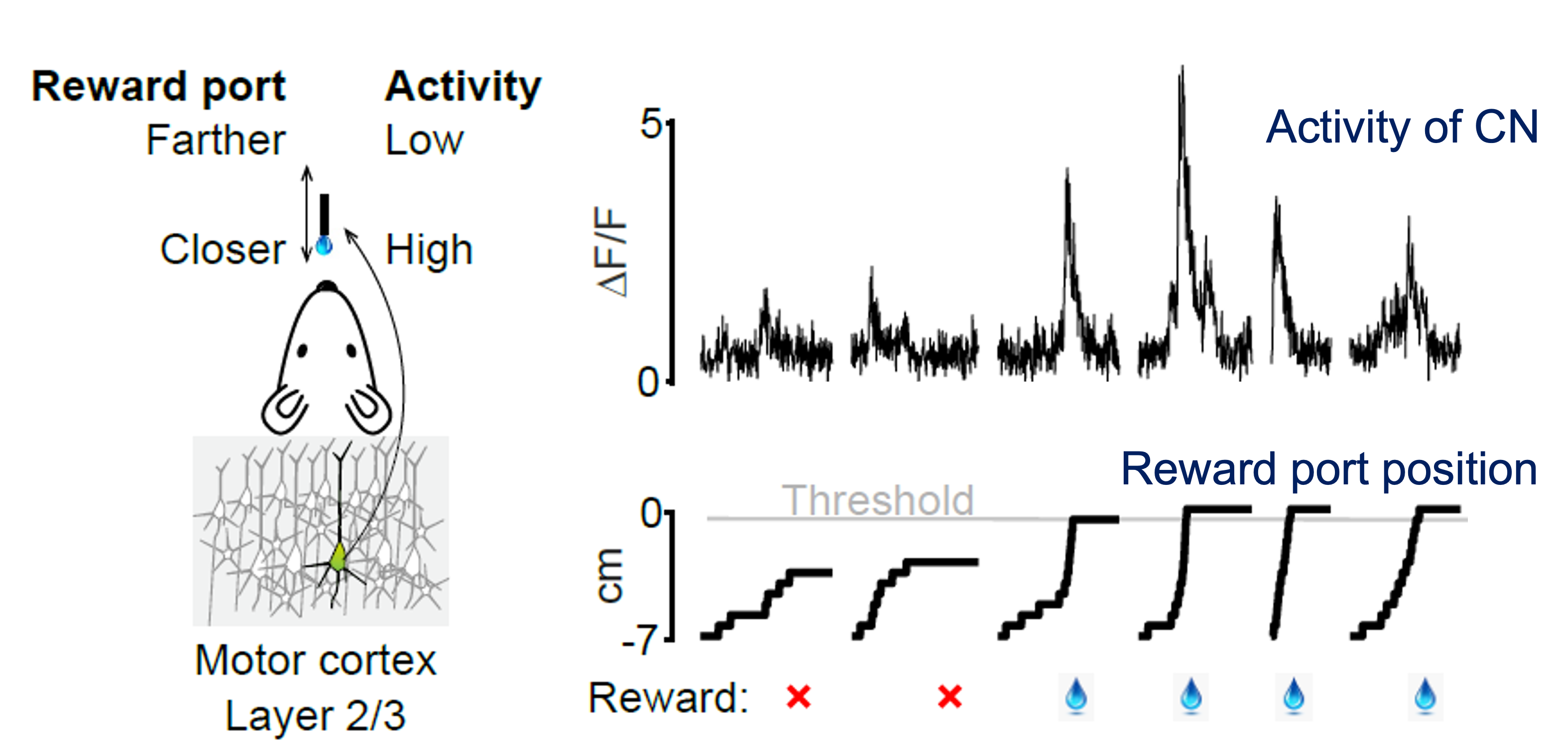
BCI Stimuli#
Each experimental session consisted of 3 epoch types: spontaneous, photostimulation, and BCI. The spontaneous and photostimulation epochs were repeated 2 times - once before and once after the BCI task to allow for comparison of neural activity and functional connectivity before and after learning.
Spontaneous Activity#
In the spontaneous epochs (spont and spont_post), mice were recorded without any instructed behavior. No visual stimuli or mean luminance screen was presented (unlike other datasets such as Visual Coding, Visual Behavior, or V1 Deep Dive).
In addition to providing a baseline of population activity and correlations, the pre-BCI spontaneous epoch served two additional purposes:
Conditioned neuron (CN) selection - one neuron was identified based on high activity modulation and weak selective tuning around trial start
BCI calibration - the spontaneous fluorescence of the CN sets the lower (F_L = median) and upper (F_U = maximum) thresholds used to control the lickport during the BCI task.
The post-BCI spontaneous epoch provides a matched baseline to measure changes in neural activity following learning.
Photostimulation#
Holographic two-photon photostimulation was used to optogenetically activate individual neurons in each trial. In this variant of the task, 1 neuron was stimulated per trial, 50-100 neurons were stimulated in total in the FOV, each neuron was stimulated ~20 trials in randomized order. The same stimulation order from the pre-BCI photostimulation epoch was repeated for the post-BCI photostimulation epoch for direct comparison.
Important
Important Note: The laser stimulation creates a light artifact that activates GCaMP. Neural activity responses during the stimulation period should be excluded from analysis.
BCI Task#
In the BCI task, mice controlled the movement of a motorized lickport using the real-time fluorescence of the conditioned neuron (CN). The raw fluorescence of the CN is converted to a voltage (0-3.3V) that drives the step frequency of the lickport motor. The mapping is linear between two thresholds calibrated from the spontaneous epoch:
F_L (lower threshold): median CN fluorescence during spontaneous activity
F_U (upper threshold): maximum CN fluorescence during spontaneous activity
Activity below F_L produces no movement. Activity above F_U drives the lickport at maximum speed.
Trial structure:
Lickport starts 7mm away from the mouse’s mouth
An auditory cue signals trial start
The mouse has 10s to move the lickport to the reward position (6mm of travel) by increasing CN activity
If successful (hit), water reward is delivered
Next trial starts after CN activity drops below F_L for ≥ 200 ms followed by a 2s delay
On failure (miss): lickport retracts and a new trial begins
Important
The BCI thresholds (F_L and F_U) are determined by the experimenter during the session based on raw fluorescence activity, which is not stored in the NWB files (only dF/F is available).
Additionally, thresholds are dynamically adjusted during the experiment to make the task progressively more difficult. Because the raw signal used for the BCI task is not recoverable from the NWB data, quantitative comparisons of behavioral performance within a session or with respect to task difficulty are not recommended.